#14: complexity, racecars and rainforests
feat. Dave Snowden

this issue of Idea Thrift Store is brought to you by: zaid getting annoyed by leaders throwing out the word complex to really say don’t even bother trying, we got this you fools
This week’s idea is really part of a huge idea – an entire franework called Cynefin created by Dave Snowden (it’s Welsh, and pronounced this way). But it’s too big for this post, so I’m going to leave the extra reading at the end[1].
Complexity science and sensemaking is really nerdy stuff, so explore it if you are curious. But this newsletter is about sharing a single idea, and this is this week’s:
🌳 rainforests are complex, 🏎️ racecars are complicated
The best, clearest summary of Cynefin is in this Harvard Business Review article here, but this is the clearest paragraph I wanted to leave you with:
In a complicated context, at least one right answer exists. In a complex context, however, right answers can’t be ferreted out.
It’s like the difference between, say, a Ferrari and the Brazilian rainforest. Ferraris are complicated machines, but an expert mechanic can take one apart and reassemble it without changing a thing. The car is static, and the whole is the sum of its parts. The rainforest, on the other hand, is in constant flux – a species becomes extinct, weather patterns change, an agricultural project reroutes a water source – and the whole is far more than the sum of its parts.
This is a Great Idea, because you can hang so many more thoughts onto this one idea.

What seems complex to us might actually be complicated – it’s a known problem. We might not have the skills, knowledge or blueprint to fix a Ferrari, a watch or iPhone but find an expert and it’s going to be solvable. You can learn from the expert.
But the rainforest? Or high school dropout rates? Or low trust in the community? None of these are static systems and none have clear causes and effects. Everything affects everything all the time– and every intervention is a guess. An expert’s guess is still a guess.

Can we make better quality guesses? Definitely. But is one hero-genius-saviour gonna save the rainforest? Nope. He’s more likely to burn it down as he treats it like a Ferrari to be fixed.
expertise has its place – in both domains
I love experts. I love people dedicated to a specific field of knowledge, the ultra-nerds who have read every book and paper backwards. We need more experts, not less.
But experts need to take Uncle Ben’s advice. Knowledge is power, and power desperately needs wisdom to put that knowledge in its proper place.
In a complicated situation, experts need to step up and simplify.
In a complex one, experts have to put everything we do know out there and let everyone bring their best efforts within this space. We have to honestly differentiate between the facts/dangers and our guesses, because nobody has the answer.
Racecars are complicated, rainforests are complex. Know the system you’re in and we’ll have a better shot at making it better.
anyway that’s the idea,
zaid
[1] If you want to get deeper into Cynefin, a good place to start is what Dave Snowden himself defines it as, from cynefin.io:
Cynefin is a framework for understanding what kind of problem space you are in to guide decisions-making and action.
& here how it looks like as a diagram:
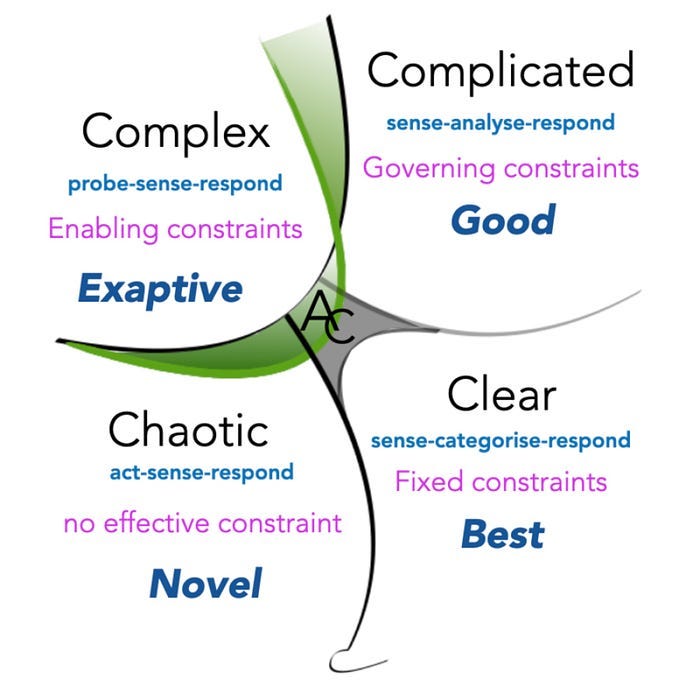
One key thing emphasised is that this is not a method – while life would be much easier if everything was in the clear domain of best practices, that’s never going to happen. A situation might also evolve, or the scale you’re looking at it might determine which domain it’s in. As Dave says, it’s an Idea to help you understand, and then guide.
The ironic thing to me is that Dave has ordered something chaotic like understanding the world into a simple or perhaps slightly complicated way of seeing it…
…but the way it’s explained always seems complex.
Good thing I’m a facilitator who likes making things easy and experiential learning then, because I have gathered some activities to help more people grasp this (in my opinion) super useful idea…without having to read a word of theory. Here’s the bonus challenge then: tell me how would you explain complicated vs complex?
PS: Let me know if you’d like to try the activities.